Co-produced transformative knowledge to accelerate change for biodiversity
Co-produced transformative knowledge to accelerate change for biodiversity

January 2026
J. Börner, D. Braun (UBO); I. Vázquez-Rowe, R. E. Manrique-Muñante (PUCP); K. Kuipers, H. Zheng (RBU); I. Richter, M. Reitstøen Arnesen (NTNU); C. Zoumides, F. Economou, E. Panayi
This policy brief synthesises empirical evidence from Work Package 3 (WP3) of the
RAINFOREST project to inform policymakers, public authorities, and other decision-
makers involved in biodiversity-relevant governance across food and biomass
systems. Drawing on five international case studies spanning consumer behaviour,
tourism, global commodity chains, and international regulation, it highlights
common challenges, enabling conditions, and policy-relevant insights for designing
effective, socially acceptable, and implementable policies that can support
transformative change for biodiversity conservation.
[...] Read more
October 2025
Bonn.realis, NTNU, IIASA, RU, SGN, UBO, CYI, PUCP
Stakeholder engagement was a crucial element in the success and
outcomes of the RAINFOREST project. Building on the stakeholder
reference group established at the project's outset, various stakeholder
workshops were organised over the three years to co-produce effective
and just pathways for meeting EU and global biodiversity targets through
the transformation of the food and biomass sector. RAINFOREST’s final
expert stakeholder workshop, as part of Work Package 5, was held online
on October 22nd from 3pm to 5pm CEST.
[...] Read more
August 2025
Evridiki Panayi, Florentios Economou, Elias Giannakis, Christos Zoumides (The Cyprus Institue)
The RAINFOREST project aims to enable, upscale and accelerate transformative
change to reduce the biodiversity impacts of major food and biomass value chains.
Within this objective, the case study on the food supply chain in Cyprus’s tourism
industry serves as an example of how tourism-driven economies exert pressure on
global food trade patterns. In particular, it aims to map and assess environmental
and socio-economic impacts of the food chain for the touristic industry in Cyprus.
[...] Read more
August 2025
C. Wong (IIASA)
The majority of previous policy analysis has focused on institutional barriers to implementation; including fragmented
policy frameworks, a lack of long-term and diversified funding, and insufficient technical and
institutional capacity.
[...] Read more
August 2025
C. Wong (IIASA)
In the IPBES (2022) Assesment Report on the Diverse Values and Valuation of Nature,
Values and worldviews are identified as "deep leverage points" that increase the effectiveness
and stability of policy interventions because they impact policy acceptibility through their adherence
to skateholder worldviews and values.
[...] Read more
August 2025
E. Panayi, F. Economou, E. Giannakis, C. Zoumides (The Cyprus Institute)
Cyprus’s tourism sector - a cornerstone of the economy - exerts significant pressures
on food systems and biodiversity, highlighting an urgent need for transitioning
governance in the food touristic chain. This policy brief identifies key governance
challenges and opportunities in the touristic food chain and recommends national
and industry-level policy actions to enable transformative pathways for sustainable
food systems in the touristic industry that benefit biodiversity.
[...] Read more
July 2025
E. Woodhouse, C. Wong, L. Nowak, T. Kastner, D. Braun, T. Schinko, J. Boerner, M. Kozicka, S. Rouet-Pollakis and D. Leclère
This report introduces the VITAL-PATHS-FOOD and the work the RAINFOREST has
undertaken in developing them. It builds on Report D1.1 which reviews the
foundational elements needed to produce new value-explicit pathways, and
describes the overall approach. This report (D1.2) introduces the toolkit the
RAINFOREST project has utilised to build and incorporate plural worldviews into the
VITAL-PATHS-FOOD (Section 1: Overall Approach) and details the methodological
approach taken in revising the draft pathways presented in D1.1 (Section 2: Summary
of Methods) including reporting on our stakeholder engagement
[...] Read more
June 2025
L. Nowak, D. Leclère, S. Rouet-Pollakis, C. Wong, E. Woodhouse, T. Kastner
D1.3 contains data and a metadata file (inludeding details on included data
files and their structure) for the downscaling scenarios in the context of KMGBF
targets 3, 7 and 16, while D1.2 contains a section describing the underlying rationale,
methods and data in more detail and highlighting some results and next steps.
[...] Read more
May 2025
H. Zheng, K.J.J. Kuipers, Z. Zhang, Y.Zhang, M.A.J. Huijbregts, M. Kulak
As climate change and biodiversity loss accelerate, understanding corporate
environmental impacts has become a priority for governments, companies, and
investors. This study evaluates the greenhouse gas (GHG) and biodiversity footprints
of 2563 companies in the MSCI ACWI, providing a comprehensive analysis across
sectors, the identification of companies with highest footprints, and the
quantification of investment portfolio-level footprints.
[...] Read more
July 2024
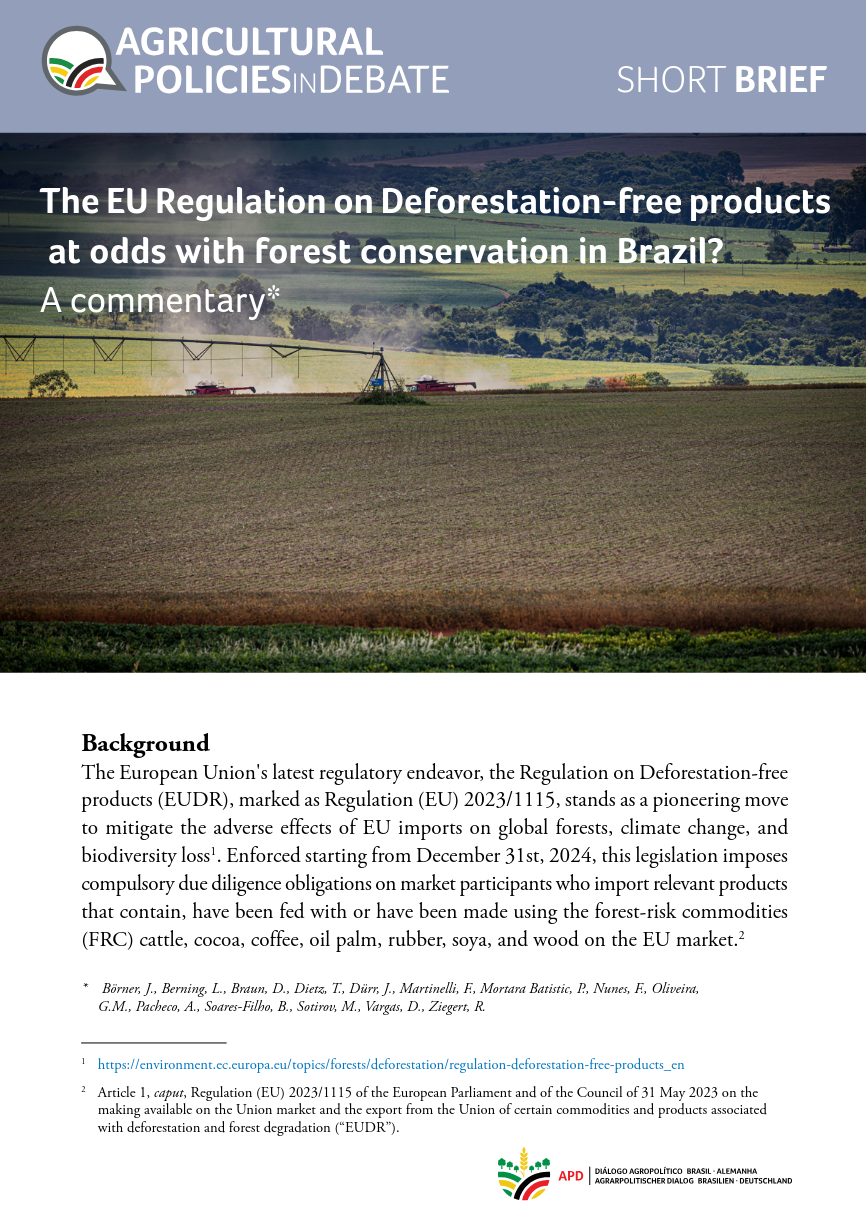
J. Börner,L. Berning, D. Braun, T. Dietz, J. Dürr, F. Martinelli, P. Mortara Batistic, F. Nunes, G.M. Oliveira, A. Pacheco, B. Soares-Filho, M. Sotirov, D. Vargas, R. Ziegert
The European Union's latest regulatory endeavor, the Regulation on Deforestation-free
products (EUDR), marked as Regulation (EU) 2023/1115, stands as a pioneering move
to mitigate the adverse effects of EU imports on global forests, climate change, and
biodiversity loss. Enforced starting from December 31st, 2024, this legislation imposes
compulsory due diligence obligations on market participants who import relevant products
that contain, have been fed with or have been made using the forest-risk commodities
(FRC) cattle, cocoa, coffee, oil palm, rubber, soya, and wood on the EU market.
[...] Read more
June 2024
Francesca Verones, Marion Lebrun, Koen Kuipers, Yeqing Zhang
The aim of this second stakeholder workshop was to update and inform the
stakeholders about the progress and to discuss and develop strategies for the way
forward. Preliminary results of models, pathways, and targets, as well as societal
and governance aspects linked to these pathways would be presented and discussed,
to ensure that expectations of stakeholders can be met and adapted to.
The set-up for the workshop was hybrid. Only one stakeholder was present
physically, the other participated online (see participant list). We structured the
workshop into 5 distinct sessions, with an input presentation each, followed by a
discussion in each session. Minutes were taken in all sessions.
[...] Read more
May 2024
L. Nowak, T. Kastner (SGN); I. Richter, K. Stadler (NTNU)
Food and biomass production systems are among the most prominent drivers of
biodiversity loss worldwide. Halting and reversing the loss of biodiversity therefore
requires transformative change of food and biomass systems, addressing the nexus
of agricultural production, processing and transport, retailing, consumer preferences
and diets, as well as investment, climate action and ecosystem conservation and
restoration. The RAINFOREST project will contribute to enabling, upscaling and
accelerating transformative change to reduce biodiversity impacts of major food and
biomass value chains.
[...] Read more
May 2024
Koen Kuipers, Larissa Nowak, Thomas Kastner, Felicity Addo, Martin Dorber, Edgar Hertwich, Mark Huijbregts, Marta Kozicka, David Leclère, Sibylle Rouet-Pollakis, Kajwan Rasul, Isabel Richter, Konstantin Stadler, Yeqing Zhang, Hanzhong Zheng, Christos Zoumides, Evridiki Panayi, Florentios Economou, Francesca Verones
RAINFOREST aims to explore pathways for transformative change to reduce biodiversity impacts of major food and biomass value chains. This includes the
development of broad-scale pathways (Work Package 1), but also case-studies of interventions that may achieve transformative change such as improving fishmeal
production technologies (WP3), changing food consumption patterns (WP3), considering environmental footprints in investment portfolio decisions (WP4), and
consuming novel foods (WP5).
[...] Read more
March 2024
H. Zheng, K.J.J. Kuipers, M.A.J. Huijbregts (Radboud University), M. Kulak (Robeco Switzerland)
This case study aims to develop and apply a methodology to quantify climate and
biodiversity footprints of investment portfolios. The white paper aims to provide an
overview of the approach, data requirements, and interpretation of the results. We
quantify climate and biodiversity footprints of individual companies in several steps.
[...] Read more
January 2024
D. Leclère, C. Wong, L. Nowak, T. Kastner, D. Braun, K. Kuipers, T. Schinko, J. Boerner, M. Kozicka, I. Richter
Transformative change has emerged as a central concept framing the action needed to achieve sustainable futures and is increasingly targeted by multilateral
agreements for climate and biodiversity. There is however limited knowledge about what might be feasible targets and pathways for transformative change in EU food
and biomass supply chains, and how this could vary according to alternative
worldviews.
[...] Read more

January 2024
D. Leclère, C. Wong, L. Nowak, T. Kastner, D. Braun, K. Kuipers, T. Schinko, J. Boerner, M. Kozicka, I. Richter
June 2023
F. Verones, E. Hertwich, D. Leclère, C. Wong, K. Kuipers, L. Nowak, T. Kastner, D.Braun, J. Börner
Stakeholder engagement is key to the success of the RAINFOEST project as it seeks to co-produce effective and just pathways to meet EU and global biodiversity targets
through the transformation of the food and biomass sector. To this end, a stakeholder reference group was created with representatives from government
institutions, academia, civil society, and industry.
[...] Read more